


Many moms we speak to are confused about exercising after a c-section.
We’ve put together some tips on how to get started safely with gentle mobilizations, breathwork and a focus on reconnecting to your tummy and pelvic floor.
Once you’re confident and reconnected to your core you can start to introduce some more of these gentle restorative exercises.
What is a C-Section and When Can You Start Exercising After One?
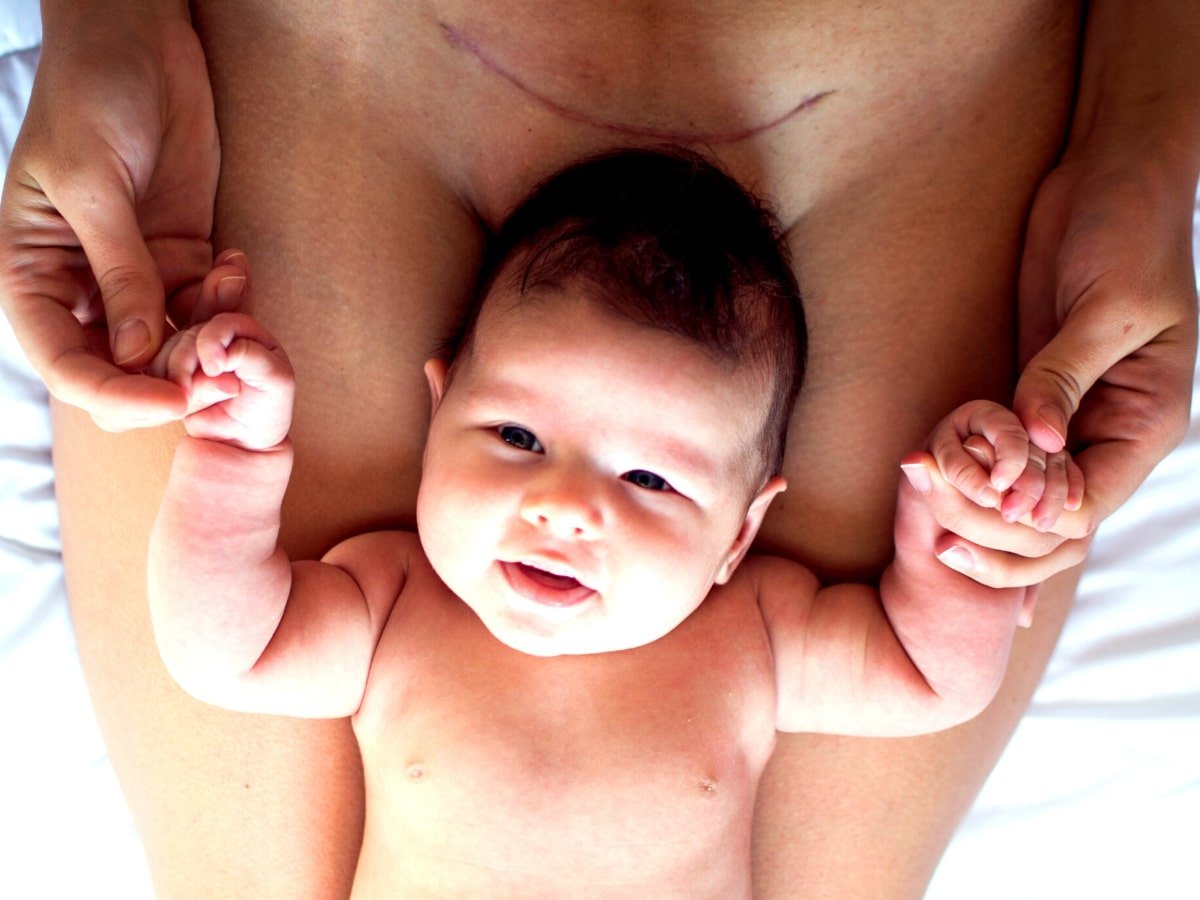
A Cesarean surgery, also known as a C-section, is a surgical procedure used to deliver a new baby through incisions made through abdomen and uterus.
These incisions are typically done when a vaginal birth would put the mother or the baby’s health at risk or when a vaginal delivery is not possible or advisable.
Note that the surgeon manually separates the two strips of rectus muscle (that’s the rectus abdominis, or your ‘six pack muscle) at the midline to gain access.
This is important – your muscles have not necessarily been cut!
It is the most common major surgery for women in the US, accounting for around 1 in 3 births.
But the fact that it happens frequently, shouldn’t downplay the physiological trauma your body has undergone.
It is a major invasive surgery requiring significant recovery. Giving birth, however we do it, is a huge achievement.
And exercising after your C-Section needs to be appropriate and progressed gradually.
Exercising after a C-Section: Where To Start
When it comes to exercising after a cesarean delivery you should start with gentle mobilization as soon as you can.
Your focus during the early weeks won’t be “working out” but rather foundational breathing and re-connecting your brain to your tummy and your pelvic floor.
The sooner you do this after any type of birth, the better.
You need to re-establish this reconnection so any exercise you eventually do will be truly beneficial. Especially in helping to resolve common post c-section symptoms like back pain.
Why is your core so important after having a baby?
You need your core if you want to stand up, sit, move, twist, pull, push, bend or turn- all of which are movements you are doing in everyday life.
Your core is connected (literally) to the muscles of your pelvic floor, which you need to prevent you from peeing or having a prolapse and in general want to be functional and healthy.
You also need a good connection and recruitment of your core muscles to help close diastasis recti or separation of your abdominal muscles postpartum and to ensure your core is supporting your body.
Your core is the foundation of your body!
1. Core engagement (breathing and pelvic floor contractions)
Proper engagement of your core is probably one of the most misunderstood muscle actions.
This simple breathing technique combined with coordinated pelvic floor contractions will reconnect you to your tummy and teach you how to engage your entire core system of muscles – whilst you rest and recover.
Practice breathing with coordinated pelvic floor muscle contraction a few times a day.
You can do this as you rest and recover or as you feed your baby. Take long slow breaths, exhaling with gentle muscle contractions, inhaling with a complete release and relaxation of the muscles.
How to do the core engagement breathing technique:
- Imagine your abdomen as a clock, with your belly button at 12 o’clock, your pubic bone at 6 o’clock, and your hip bones as 3 o’clock and 9 o’clock.
- Imagine you are slowly and gently drawing the hip bones, or 3 and 9 o’clock, together.
- It will also work if you imagine you are drawing them apart! Don’t worry that you can’t feel much happening for now. Go gently and do the movement on a long, slow exhale.
- At the same time, engage your pelvic floor muscles.
You will most likely experience numbness around your scar site, so feeling what is going on in your core can be hard.
The common visualization of ‘gently drawing belly button to spine’ may be unhelpful as you may not be able to feel this movement.
If you need more guidance on how to engage your core go here – where we go into more detail on this technique.
Restorative Exercises For C-Section Recovery: Taking it a Step Further
Once you have gotten the hang of reconnecting to your core and pelvic floor you can start to add in some gentle restorative exercises. These are still safe for the early days postpartum.
Always be in tune with your body, nothing should cause strain or pain. These movements are slow, gentle, and controlled.
2. Banded Breaths
This simple exercise is to reconnect you to your diaphragm, core and pelvic floor.
The band will help you to connect to your diaphragm. You should feel your ribcage under the band expand with your breathing.
How to do banded breaths:
- Grab a band, towel or belt
- Wrap it around your rib cage and gently hold it there
- Exhale and draw your pelvic floor up
- Inhale release everything
- Repeat for a total of 8 breaths
3. Banded Clams
This exercise is to reconnect you to your glute muscles.
Weak glutes play a role in core and pelvic floor dysfunction. You need your glutes to be firing and working to support your body in daily movements and exercises!
How to do banded clams:
- Grab a loop band
- Wrap it around your knees
- Lie down on your side
- Exhale as you open your top leg focusing on using and feeling your glutes (bum!)
- Inhale and release glute engagement as you lower leg back down
- Repeat 5 times on both sides
4. Banded Pull Aparts
This exercise will help reconnect you to your tummy, core muscles and pelvic floor, which is especially important during your postpartum recovery.
Placing a hand on your core during the move can help that mind to muscle connection.
How to do banded pull aparts:
- Grab a loop band
- Wrap it around your knees
- Lie on your back
- Exhale as you lift your pelvic floor up and engage your core
- Pull your knees apart creating gentle tension in your band
- Inhale bring knees back together and release engagement
- Repeat for a total of 8
Resuming exercise after a c-section: Take things slowly
Remember that everyone’s recovery after a C-section is different, so it’s important to take things at your own pace and not compare yourself to others.
By taking care of your body, you can safely and gradually get back to functional movement and beyond.
Practice these breathing and muscle engaging exercises as you rest and recover, and as you feed your baby.
Take long slow breaths, exhaling with gentle muscle contractions, inhaling with a complete release and relaxation.
Remember to always roll to your side first as you get up from lying on your back, don’t sit straight up.
And totally avoid sit-ups or crunches.
Go for a walk outside as soon as you feel able, and try to make this a daily activity. Walking and fresh air will help your emotional health, as well as increase circulation to aid healing and scar tissue.
Diet and nutrition after a C-Section
Lastly, the food you eat is massively important for your body’s ability to heal after c-section.
Try to eat a diet rich in clean protein, with plenty of green and deep coloured vegetables, berries, essential fats and fibrous vegetables and fruits for good gut health.
Include anti-inflammatory foods such as garlic, green tea, turmeric and ginger.
Good hydration is vital. Drink lots of water, herbal teas and water-rich foods.
Stress, lack of sleep (I know.. unavoidable for new mums!) and inflammatory ‘comfort’ foods or drink like sugar or alcohol will slow healing.
So really, really try to…rest!
In the early days, massage, mobilize, find and focus on strengthening your deep muscles. Eat clean fresh food to recover and nourish your body.
But most important of all, relax, insist people rub your feet and bring you tea, get as much sleep as you possibly can and love your body. It’s achieved something amazing.
If you have just started exercising after your caesarean birth, please comment below and let us, and other MUTU Mamas, know how you are getting on.






I am 1 year postpartum and they had to do a c-section. The other day I did an ab workout, that day it felt fine but the next morning and today it feels like I just had my c-section. Should I be concerned?
Hi Kaitlyn, We are absolutely not medically trained nor qualified in any way to diagnose, assess or even give an opinion on your personal condition. We cannot comment on your individual medical circumstances.
If you are in ANY pain during or after exercise, please cease the activity immediately and do not return to it until you have consulted with a medical Doctor. Put simply, if something hurts, stop doing it and don’t do it again until you have discussed your program and agreed on a course of action with your Doctor.
I had a C Section September 20th, 2020. Now it feels like something leaking or running inside my lower abdomen. Is this normal or part of the healing process?
Hey Tabitha, we really do understand your frustration and desire for information and answers. Not understanding the way your body is behaving or feeling can be upsetting and may mean you feel disconnected from your body. We want to help and provide all the resources we possibly can to help and ask you to appreciate that we are not medically trained nor qualified to diagnose, assess or comment on your personal condition, nor can we advise beyond the scope of our program.
If you have unexplained discomfort or lack of function anywhere in your abdomen or pelvis or, if your diastasis or connective tissue is not responding to the consistent practice of MUTU restorative work, we strongly recommend you consult with a Women’s Health/Pelvic Physical Therapist for individual assessment, diagnosis & movement prescription. This page gives you detailed information on knowing when you may need specialist help, and how to find it.
I had an exploratory abdominal
Surgery approx 40 years ago (I was 2) that mimicked a C-Section as I was cut almost hip bone to hipbone. I have been riddled my entire adult life with a less than desirable “shelf“. This shelf isn’t super flabby and is in fact rather taut (I’m assuming it is mainly muscles). Is there anyway outside of surgery to minimize its size? Also, will regular abdominal exercises cause it to bulk? I have been scared to exercise my abs my entire life for fear of it getting bigger. Thanks!
Your shelf isn’t muscle Lovely, sorry. It’s scar tissue with fat on top. 40 year old scar tissue… To shift it you need targeted manual therapy, (ie massage therapy but from an expert not a beauty therapist). Any ‘bulk’ isn’t and wouldn’t be due to bulky muscle, its scar tissue. Heavy weight training would gain muscle mass – which would push the scar tissue and fat outwards (wherever on the body it was). What we do is not heavy weight training. You don’t build ‘bulk’ on your abs. We do gentle core restoration and strengthening. No ‘mass’ created. Movement, activity, exercise will all help increase circulation to help dissipate scar tissues. Good nutrition, plentiful hydration – lots of water – will make a huge difference. But that tissue has sat there all knotted up for a long time, manual therapy will help.
The connection element of MUTU will also help. Your body hasn’t been ‘connected’ to those muscles in a very long time…
Hi! I had a c section almost 10 years ago and recently started doing ab work outs to get toned. I am having some excruciating pain when i do crunches. Some ab workouts i can do and it doesnt hurt as much but crunches feels like my scar is tearing and on fire. Is this normal? Should I stay away from full blown crunches?
Hi Monika, if you are suffering with pain please stop the exercise and consult with your medical professional. We are not able to provide medical advice, opinion, diagnosis, treatment or medical services of any kind.
Hi there , in general, how long after a c section can I start the program? I read the article above which states to focus on ” finding” the right muscles again. Does this mean I can start the program after 6 weeks ?
Thanks ! 🙂
Hi Krista, you should wait a minimum of at least 10 weeks following a c-section, before commencing the Intensive workouts in the MUTU Program. The first Core Phase of the MUTU Program, is safe to start in the early days after birth. This foundation stage of the program is designed to help you locate and restore connection to your core muscles. They are really gentle, helping you to re-connect with your body and increase circulation to your core and pelvic floor to aid healing. The daily walk advocated in all our programs is healthy and nourishing to start as soon as you feel able.
Always seek medical approval from your doctor before starting any exercise program after childbirth and read our Medical Disclaimer.
I had a cesarean a year ago and started doing crunches and abdominal excercise for about two weeks now and I now have pain on my left side by my scar area and it feels like there might be a knot or ball just beneath my scar area it just started hurting around in that area and hurts when I use the bathroom. Not sure if I tore something or if I’m just sore from not working out for about two years ?
Hi Erika, it’s lovely to hear from you, we are absolutely not medically trained nor qualified in any way to diagnose, assess or even give an opinion on your personal condition. SO we cannot comment on your individual medical circumstances.
If you are in ANY pain during or after exercise, please cease the activity immediately and do not return to it until you have consulted with a medical Doctor. Put simply, if something hurts, stop doing it and don’t do it again until you have discussed your program and agreed on a course of action with your Doctor.
I found a website with C section workout guidelines called whattoexpect. I’m one week PP and starting to follow the workouts. My Dr said I should be cleared to start running again at 6 weeks but I’ve been working out 3-5 days a week my entire pregnancy. I will find out more at my two week appointment but if you’re feeling good walking and other light exercise should be OK. Listen to your body, part of the recovery is how fit you were before the surgery.
Is there a app we can use
Hi Jessica. We do not have an app for the program, however the membership site is completely responsive and mobile friendly. So it’s really really easy to use on your phone. 🙂
I had a c section in 1985 and a v bac in 1988. Will this work for me? I am at normal weight but can’t get rid of my baby belly.
Hey Vonni,
It’s never too late to make a difference – to get a stronger lower back, a more optimally functioning core and pelvic floor, and a flatter stomach. Your abdominal muscles are just like any other muscles – they just sit there when they’re not being used. They don’t go anywhere, or lose the ability to work… they just get weak. They may be tight or they may be slack, depending on your whole body alignment, but if they’re not being used, they are weak and ineffective.
MuTu System programs show you how to re-connect with, and restore, long-forgotten muscles, how to re-align your posture to train your core and pelvic floor muscles to work optimally and at full strength and flexibility, and how to make your stomach muscles lie flat. It doesn’t matter how long ago you had your last baby – MuTu can help. 🙂
Ive had 3 c sections years apart and not good with working out. Im 42 and dont know how to flatten my stomach. Noone told me crunches and sit ups weren’t good to do. What can i do
Hi Nae,Take a look at my 12 Week program here: https://mutusystem.com/en-us It’s designed for busy moms to fit around your schedule and the core exercises take about 15 minutes a day. You will need to get approval from your doctor before embarking on any exercise program to make sure that they are happy for you to do so. My MuTu System program helps to strengthen your core and flatten your tummy safely after having babies. You will be guided through 12 weeks of core restoring exercises and alignment adjustments.:) x
Hi
I’m Shiny, aged 45, mother of two kids aged 14 and 12. I had 2 C-sections the last of which was when I was 33. I would like to know which type of exercises are desirable for me. I feel acute shoulder pain, ankle burning, slight knee pain and back pain. Back pain is more felt when I bend.
Hi there,
MuTu System is suitable and beneficial for post c-section or multiple birth. Our programs will help you to re-connect nerve pathways and regain sensitivity and tone around your scar site, by gently increasing circulation and movement to the traumatised area through specific abdominal exercise and massage. They will make your core stronger and more stable (i.e. so that your core supports your back properly and without pain) and restore tone and function to your stomach muscles.
The extent to which you can improve the ‘apron’ c-section scar site depends on many factors. Age, genetics and skin elasticity, nutrition, the extent of weight gain and loss, how many babies, how many surgeries… all of these will affect your body’s ability to heal and your stomach skin to firm up or ‘spring back’.
No exercise programme can eliminate loose skin, but MuTu System will benefit the looks and function of your stomach significantly – in terms of muscle function, strength, stability and fat loss.
It’s really important that you check with your doctor first before embarking on any exercise program, especially if you are in pain as you mentioned above. First seek your doctor’s approval. 🙂
hi, I’ve had 1yr ago cesarean section delivery, and I do jogging this month and my menstration should be MAY 25 and it was delayed already for 3days.. is that can be affect because of jogging? tnx..
Hi there,
You will need to discuss this with your doctor. Unfortunately I cannot comment on individual medical cases.
🙂
Thanks for your kind information
Hi! I’ve had 4 csections and it’s been 26 months since last and final section. For 5 months I’ve done p90x and cross fit, plus ab training at home. My ab muscles don’t respond. They fatigue, but are never sore. The 1st I had a
T incision the rest were normal. Should I give up on having a 6 pack or is it just going to take more time
Hey Rachel.I think the first step after having babies is to really focus on rebuilding the vital foundations. Core strength.Core training isn’t just about the abs – that’s because the core isn’t just about the abs. It includes: deep muscles – the multifidus, the transverse abdominal muscle, the diaphragm and the pelvic floor; plus the muscles that are fundamental to the deep core system working effectively: the erector spinae, the rectus abdominus, the gluteus maximus and the obliques amongst others.Thats a lot of muscles. a lot of really important muscles.Training your core isn’t about sucking in your stomach, isolating and working one muscle repeatedly, or closing a diastasis gap. Its about getting a body that works right.I cover this in more detail over here: https://mutusystem.com/en-us/postpartum-exercise/ab-exercises-for-moms/I also want you to take a look at this article too as some exercises might not be helping if you have a weak or compromised core: https://mutusystem.com/en-us/postpartum-exercise/how-long-postpartum-till-i-can-crossfit-plank-run/I hope that helps 🙂 x
Hi Nisha. It’s important that you seek advise from your doctor or physical therapist on this. For now, stop doing the exercise you are doing that’s causing the pain and seek advice from a medical professional. x
Hi Nisha,
You need to seek some advice from your doctor or physical therapist. Unfortunately I am unable to advise or comment on individual medical cases.
Hi, I am Nisha I have my 1st c section about 29 month ago. Now days i have start doing some exercise but my belly was hurting after each and every time can you please tell me what kind of exercise will be better. Thanks
Hi my name is Danielle. I’ve had 2 c sections ’09 and ’12 my doctor never told me how to start excersize again. Even now 4 years later if I do sit ups I bleed. Is this normal? Should I stop doing them?
Hi Danielle. This is something you need to talk to a medical professional about. Bleeding when exercising is not normal or okay. Hold off doing any exercise that gives you symptoms like this and seek advice from your doctor. Also, check out this page about referral to a Women’s Health Physiotherapist: https://mutusystem.com/referral-to-a-womens-health-physiotherapist
Hey LEEM. Providing that your doctor is happy for you to embark on the exercise program, the core phases in the 12 week program are gentle and restorative and will help you to rebuild strength in your core and pelvic floor and can indeed be highly beneficial if your doctor is happy. 🙂
Hello I have had my c section 15 months ago have not done any exercises, and now i have a pouch and people still think and ask if i am pregnant. I could diffidently use your help! Please and thank you!
Hey Ashlee. Providing that your doctor is happy for you to embark on an exercise program, the 12 week program can help strengthen your core and pelvic floor after having babies and will help with flattening your tummy too. 🙂
Will this system help with a woman who has had an abdominal hysterectomy?
Hey Polly. this article should help. https://mutusystem.com/mutu-system-blog/crunches-curl-ups-diastasis-recti 🙂
Hey Kimberly. Yes, MuTu System is entirely suitable and beneficial for post c-section or multiple birth. Our programs will help you to re-connect nerve pathways and regain sensitivity and tone around your scar site, by gently increasing circulation and movement to the traumatised area through specific abdominal exercise and massage. They will make your core stronger and more stable (i.e. so that your core supports your back properly and without pain) and restore tone and function to your stomach muscles.
The extent to which you can improve the the ‘apron’ c-section scar site depends on many factors. Age, genetics and skin elasticity, nutrition, the extent of weight gain and loss, how many babies, how many surgeries… all of these will affect your body’s ability to heal and your stomach skin to firm up or ‘spring back’.
No exercise programme can eliminate loose skin, but MuTu System will benefit the looks and function of your stomach significantly – in terms of muscle function, strength, stability and fat loss. Read more on Exercise After C-Section here: https://mutusystem.com/exercise-after-c-section.html
Wendy,
I’m 33 and I have had 4 C-section and my last one was 3 years ago. Is it truly possible to lose my tummy without surgery. It’s not a lot but it’s enough to make me uncomfortable.
Polly. It isn’t wise to do sit-ups if your core is not fully functional. Especially if it’s uncomfortable at all. You need safe and gentle core exercises which you can find in my MuTu Core phases of the 12 week program. Your question around getting pregnant post C-section, you need to discuss this with a medial professional. I am unable to advise.
Hi i had my second c section on the 20th july 2016 and i have a little hole on the left side what wont heel its been open for 10 weeks i have been told i can walk and thats it, is there any other exercise can do to help me loose weight without hurting by wound ?? X
This is something you need to discuss with your doctor. Rushing back into exercise before you’re ready could make things a lot worse. Always clear exercise with a medical professional first.
I am 3 months post c section, and started doing zumba, and also weight train , this is my 2nd c section.
but my question is how long should I wait to do weight training or heavy lifting, sit ups and dead lifts..etc.
I started to spot some blood.after training for 2 days and did. the excersise i mention above..
but I havent find any specific info. in how many months. should i wait to be able to do training. like 6 ,9 or 12 months?????
Caren. Every body is different so it’s important you seek advice from a medical professional to determine when you are ready. Blood or pain during or after exercise is NOT a good sign and your body is trying to tell you something. I wrote this really useful article on how to know when you’re ‘ready’ to return to the sport and exercise you love: https://mutusystem.com/en-us/postpartum-exercise/how-long-postpartum-till-i-can-crossfit-plank-run/ It’s far better to gradually build up strength in your core and pelvic floor safely, taking it slow. Your body will then be able to cope with more intense exercise.
I had my baby 2years ago. I started situps for 2days &its abit uncomfortable. I even stopped coz i thot i was not safe to do it. Is it safe or I’m i just scared. And is it safe to get pregnant again after the c section.
I have had 4 c-sections my children are 18, 16, 12, and my twins are 9. I have started to do ab exercise and it seems tender. I question if it’s OK to do sit ups and crunches. I don’t want to injure myself, does anyone have any answers?
Hi Tikisha. Sit ups and crunches are not the best exercise you could be doing right now. If you experience any pain. Stop what is causing it. The core exercises in our 12 week program are safe and gentle and restore strength in your core and pelvic floor after having babies. You can find out which of our programs is right for you here: https://mutusystem.com/download-the-mutu-system-coaching-programme
I’ve had a c section 8 years ago. And,my tummy isn’t all that bad. Because,i a dancer,and that has helped me alot. And,i eat less drink more water. And,i cleanse my colon once a week.
HELLO,I had my c-section 8 months before,but still i have not started any exercises… please suggest me exercises to flatten my tummy…..
HELLO,I had my c-section 8 months before,but still i have not started any exercises… please suggest me exercises to flatten my tummy…..
Hi I went to zumba on Monday and I tried to do some sit ups and now my stomach hurts it feels really sore and hurts when I try to get up. I had a c section 4 months ago due to pre eclampsia and lost some blood. Is it to soon to do sit ups? Did I damage my insides?
Hi I went to zumba on Monday and I tried to do some sit ups and now my stomach hurts it feels really sore and hurts when I try to get up. I had a c section 4 months ago due to pre eclampsia and lost some blood. Is it to soon to do sit ups? Did I damage my insides?
Hi I went to zumba on Monday and I tried to do some sit ups and now my stomach hurts it feels really sore and hurts when I try to get up. I had a c section 4 months ago due to pre eclampsia and lost some blood. Is it to soon to do sit ups? Did I damage my insides?
Hello, I had my fourth csection three weeks ago and I still look pregnant.. With my other csections I did have a tiny pooch but wasn’t this bad. My scar seems higher this time could that be a reason. There are so many programs to choose from how do I know what will work. I’m ready to give up and get a tummy tuck but that’s not in my budget at the moment and who wants to get cut again. I do know I don’t want to live with this shelf above my scar. Ive seen woman who have had csections years ago and still have a big stomach. Is there hope
Hello, I had my fourth csection three weeks ago and I still look pregnant.. With my other csections I did have a tiny pooch but wasn’t this bad. My scar seems higher this time could that be a reason. There are so many programs to choose from how do I know what will work. I’m ready to give up and get a tummy tuck but that’s not in my budget at the moment and who wants to get cut again. I do know I don’t want to live with this shelf above my scar. Ive seen woman who have had csections years ago and still have a big stomach. Is there hope
3 weeks is not very long!! But check out our FAQ page where you will find answers to all your questions about your suitability for the program + what results to expect https://mutusystem.com/faq.html
Hello, I had my fourth csection three weeks ago and I still look pregnant.. With my other csections I did have a tiny pooch but wasn’t this bad. My scar seems higher this time could that be a reason. There are so many programs to choose from how do I know what will work. I’m ready to give up and get a tummy tuck but that’s not in my budget at the moment and who wants to get cut again. I do know I don’t want to live with this shelf above my scar. Ive seen woman who have had csections years ago and still have a big stomach. Is there hope
3 weeks is not very long!! But check out our FAQ page where you will find answers to all your questions about your suitability for the program + what results to expect https://mutusystem.com/faq.html
I wish I had seen this article when it was first written! Now, three years post c-section #2; I’m back to my normal weight, a little under actually, but still have a pouch that looks like I’m about 6-8 weeks pregnant! UGH!
Is it still a no no to do sit ups?
You don’t need sit-ups anyway, but you definitely don’t want to do them if your core is not fully functional. So, no to sit-ups, but get your core strong first then you can do whatever movement you like! This helps explain https://mutusystem.com/en-us/postpartum-exercise/how-long-postpartum-till-i-can-crossfit-plank-run/
I wish I had seen this article when it was first written! Now, three years post c-section #2; I’m back to my normal weight, a little under actually, but still have a pouch that looks like I’m about 6-8 weeks pregnant! UGH!
Is it still a no no to do sit ups?
You don’t need sit-ups anyway, but you definitely don’t want to do them if your core is not fully functional. So, no to sit-ups, but get your core strong first then you can do whatever movement you like! This helps explain https://mutusystem.com/en-us/postpartum-exercise/how-long-postpartum-till-i-can-crossfit-plank-run/
Your knowledge has helped me enormously, Wendy. I have been studying Pilates and cannot, no matter how hard I try, do the roll up ( sit up) which is essential for teacher training. I take on board your advice that it’s not essential to fitness. However, it makes me feel like a failure in class. I’ve always believed that scar tissue and adhesions from 2 complicated c sections and a hysterectomy have got in the way. But I’ve never had this confirmed. Now I read that adhesions etc do affect the way muscles glide over each other, and so on. My obliques over compensate – I have very strong oblique control and can execute the required exercises perfectly, but I fear I will never have the transverse abdominal fitness required for instructor qualification. Pilates is a brilliant way to be fit and healthy, but I don’t think it addresses c section and multiple abdominal surgery effects. Could you please comment? Thanks so much.
Your knowledge has helped me enormously, Wendy. I have been studying Pilates and cannot, no matter how hard I try, do the roll up ( sit up) which is essential for teacher training. I take on board your advice that it’s not essential to fitness. However, it makes me feel like a failure in class. I’ve always believed that scar tissue and adhesions from 2 complicated c sections and a hysterectomy have got in the way. But I’ve never had this confirmed. Now I read that adhesions etc do affect the way muscles glide over each other, and so on. My obliques over compensate – I have very strong oblique control and can execute the required exercises perfectly, but I fear I will never have the transverse abdominal fitness required for instructor qualification. Pilates is a brilliant way to be fit and healthy, but I don’t think it addresses c section and multiple abdominal surgery effects. Could you please comment? Thanks so much.
Adhesions + scar tissue will totally have hindered progress if not dealt with… Regardless of the discipline, you need a core that recruits optimally from the deepest level for it to be fully functional. MuTu System will help you ‘back up’ to get those foundations right so you can move forward.
Your knowledge has helped me enormously, Wendy. I have been studying Pilates and cannot, no matter how hard I try, do the roll up ( sit up) which is essential for teacher training. I take on board your advice that it’s not essential to fitness. However, it makes me feel like a failure in class. I’ve always believed that scar tissue and adhesions from 2 complicated c sections and a hysterectomy have got in the way. But I’ve never had this confirmed. Now I read that adhesions etc do affect the way muscles glide over each other, and so on. My obliques over compensate – I have very strong oblique control and can execute the required exercises perfectly, but I fear I will never have the transverse abdominal fitness required for instructor qualification. Pilates is a brilliant way to be fit and healthy, but I don’t think it addresses c section and multiple abdominal surgery effects. Could you please comment? Thanks so much.
Adhesions + scar tissue will totally have hindered progress if not dealt with… Regardless of the discipline, you need a core that recruits optimally from the deepest level for it to be fully functional. MuTu System will help you ‘back up’ to get those foundations right so you can move forward.
Hi my name is wajiha . Mother of 2 kids .C section twice. Last c section is almost 5 years before. I have never done any type of exercise (except walking ) before. .Now my weight is 200 lbs. I have tummy of size 45″ and hips of size 51″ . My thighs are also heavy.My tummy is kind of very lumpy bag full of fat. Now i wanted to loose weight I have started walking and gradually increasing time and speed. I also have cut off about 30% of the food intake i used to take. but i don’t know any of the exercises i should do.i wanted to know a few things if u kindly tell me.
1. What are the exercises i should do to burn fat from my tummy . thighs and hips?
2. Does it is possible to loose weight as much as 90 lbs?
3. Does doing any exercise other than walk hurt my inside stitches ?
4. Can i do skipping rope?
5. Please do recommend exercises that r suitable for me.( Facility of swimming and gym is not available to me)
6. Does stop exercising make muscles lumpy and loose?
Thanks
Hi there,
1. You can’t ‘burn fat’ form specific areas – body fat is distributed over your body. But this article will help explain more about fat storage https://mutusystem.com/are-hormones-lack-of-sleep-making-you-fat-6-ways-to-reduce-belly-fat-storage.html
2. Yes its possible!
3. Please see your Doctor about any pain.
4. High impact exercise is only recommended if your core + pelvic floor are fully functional + restored. Otherwise you’ll do more harm than good.
5. MuTu System 12 Week Program!
6. It simply means they’re not doing anything. Not sure about lumpy, but yes to weak. And often a weak muscle can be too tight, or tense – so weak doesn’t have to mean loose. Either way you can improve it!
Check out the programs here https://mutusystem.com/download-the-mutu-system-coaching-programme.html
Hi my name is wajiha . Mother of 2 kids .C section twice. Last c section is almost 5 years before. I have never done any type of exercise (except walking ) before. .Now my weight is 200 lbs. I have tummy of size 45″ and hips of size 51″ . My thighs are also heavy.My tummy is kind of very lumpy bag full of fat. Now i wanted to loose weight I have started walking and gradually increasing time and speed. I also have cut off about 30% of the food intake i used to take. but i don’t know any of the exercises i should do.i wanted to know a few things if u kindly tell me.
1. What are the exercises i should do to burn fat from my tummy . thighs and hips?
2. Does it is possible to loose weight as much as 90 lbs?
3. Does doing any exercise other than walk hurt my inside stitches ?
4. Can i do skipping rope?
5. Please do recommend exercises that r suitable for me.( Facility of swimming and gym is not available to me)
6. Does stop exercising make muscles lumpy and loose?
Thanks
Hi there,
1. You can’t ‘burn fat’ form specific areas – body fat is distributed over your body. But this article will help explain more about fat storage https://mutusystem.com/are-hormones-lack-of-sleep-making-you-fat-6-ways-to-reduce-belly-fat-storage.html
2. Yes its possible!
3. Please see your Doctor about any pain.
4. High impact exercise is only recommended if your core + pelvic floor are fully functional + restored. Otherwise you’ll do more harm than good.
5. MuTu System 12 Week Program!
6. It simply means they’re not doing anything. Not sure about lumpy, but yes to weak. And often a weak muscle can be too tight, or tense – so weak doesn’t have to mean loose. Either way you can improve it!
Check out the programs here https://mutusystem.com/download-the-mutu-system-coaching-programme.html
Thank you I will try but I have the bottom part of my stomach that’s 4inches or 5 of fat and I can’t seem to tighten it but its by the c section scar they said I may never be able to tighten it. I’m not sure though.
Thank you I will try but I have the bottom part of my stomach that’s 4inches or 5 of fat and I can’t seem to tighten it but its by the c section scar they said I may never be able to tighten it. I’m not sure though.
Don’t worry about the models on TV for goodness sake Ashley! If you have no excess weight but a protruding stomach then excess intra abdominal pressure / diastasis is likely to be an issue. you need to re-align your body + restore your core. The MuTu programs will help – choose 12 Week if you want the holistic whole body program which will give you pull body workouts as well (its not about losing weight, but getting your whole body right where you want it!)
I had my son to you 2 years ago almost 3 in December and I started working out probably2 weeks after I had my son I started working out and I had ac section so it took me 2 years for my belly to go down and its still not small enough I can’t get abs and I don’t work out no more but I was 168 now I weigh 110 and I’m 5foot 6I’m 21 years old and I cant seem to get any enough like models on t_v I am aware that I am under wait but I look in thr
mirRor my weight doesn’t match my stomach
Don’t worry about the models on TV for goodness sake Ashley! If you have no excess weight but a protruding stomach then excess intra abdominal pressure / diastasis is likely to be an issue. you need to re-align your body + restore your core. The MuTu programs will help – choose 12 Week if you want the holistic whole body program which will give you full body workouts as well (its not about losing weight, but getting your whole body right where you want it!)
I had my son to you 2 years ago almost 3 in December and I started working out probably2 weeks after I had my son I started working out and I had ac section so it took me 2 years for my belly to go down and its still not small enough I can’t get abs and I don’t work out no more but I was 168 now I weigh 110 and I’m 5foot 6I’m 21 years old and I cant seem to get any enough like models on t_v I am aware that I am under wait but I look in thr
mirRor my weight doesn’t match my stomach
Don’t worry about the models on TV for goodness sake Ashley! If you have no excess weight but a protruding stomach then excess intra abdominal pressure / diastasis is likely to be an issue. you need to re-align your body + restore your core. The MuTu programs will help – choose 12 Week if you want the holistic whole body program which will give you pull body workouts as well (its not about losing weight, but getting your whole body right where you want it!)
Thank you I will try but I have the bottom part of my stomach that’s 4inches or 5 of fat and I can’t seem to tighten it but its by the c section scar they said I may never be able to tighten it. I’m not sure though.
My name is blessing, Pls am a mother of 3 kids, gave birth through 3 C-Section. The last one was 4 years ago…… I had gained lots of weight constantly mostly around my stomach and my upper arm. Whenever I try to do tummy sit-ups to loose tummy fat, I experience a strange very severe abdominal muscle tightness and twitches. This makes me cry and shout so much. This is really scary and disturbing…… What’s actually the cause and solution pls.??????
Tnx
Hi Blessing – We really do appreciate your need for information and answers. Not understanding the way your body is reacting or feeling, can be scary and upsetting. If you are experiencing any pain whilst exercising – you must STOP what you are doing and contact your medical caregiver to obtain an accurate and individualised assessment of your situation. Please contact your Doctor
after my pregnancy i started my exercise on 10th month. Is it possible to decrease belly and it takes how many months
Every one is different Santhi, if you follow the program for full core recovery as well as the nutritional guidelines to help you lose fat, you’ll get there!
after my pregnancy i started my exercise on 10th month. Is it possible to decrease belly and it takes how many months
Every one is different Santhi, if you follow the program for full core recovery as well as the nutritional guidelines to help you lose fat, you’ll get there!
Wendy,
I purchased your Focus program about 3 weeks ago when
I realized I had a diastasis about 2-3 finger widths wide. I am 36 weeks
pregnant with my 2nd child.
I am fairly certain I had a diastasis before that had narrowed
significantly to 1 finger width; I did not do much to narrow it as my stomach
was very flat and I had good muscle tone, but a slight doming existed even a
few years after my first pregnancy (Luckily, I’ve never felt the need to
participate in “hard core” ab workouts that contain crunches, etc!). This time
I will try harder, however, to strengthen my core. I have been doing the
focus exercises and stretches each day in the hope my diastasis will at least
not get worse in the few weeks before I have my daughter.
To compound matters,
I found out last week and it was confirmed today that the baby is breech. So,
unfortunately I will be having a scheduled c-section unless she turns. This is
upsetting b/c I felt that my lower abs were actually well connected and
engaged. I think my diastasis is much higher, ending (I think) around my belly
button. All this has been hard to swallow as I’ve always been very active and
very petite. I’m 5’ and weighing 115lbs now at 36 weeks. I’ve really managed to stay slim, but healthy. Is having the c section going to make my recovery significantly more challenging than the diastasis would have, in your opinion? I was devastated enough to have to deal with that and am feeling very overwhelmed to also have to recover from a c-section…Not to mention I really wanted another natural birth 🙂 I am assuming that weight loss and belly fat will not be an issue thanks to genetics, but I am still worried about the bulge coming from a weakened core. Any thoughts/advice would be appreciated. Thanks!
Hi Natalie, I’m sorry I missed this comment – if you are a customer you know you can contact us directly via the private group on Facebook or by email – its much quicker! I’m so sorry you feel disempowered regarding your birth, but of course you must do what is safest for you + your baby. Giving birth is an achievement – however you do it! You can’t change those things, you must do the right thing for your body right now… so don’t worry about them. Focus is perfect for you right now provided you feel good doing it. ANY move that doesn’t feel good, stop doing it. You will repair + recover + restore afterwards… don’t worry. Work with your body, not against it, its doing its best 🙂 Please use the private Facebook group (if you’re not in there yet, email [email protected] giving the email address you purchased with) as you will find a tonne of support + can get direct help from me + my team there too
Wendy,
I purchased your Focus program about 3 weeks ago when
I realized I had a diastasis about 2-3 finger widths wide. I am 36 weeks
pregnant with my 2nd child.
I am fairly certain I had a diastasis before that had narrowed
significantly to 1 finger width; I did not do much to narrow it as my stomach
was very flat and I had good muscle tone, but a slight doming existed even a
few years after my first pregnancy (Luckily, I’ve never felt the need to
participate in “hard core” ab workouts that contain crunches, etc!). This time
I will try harder, however, to strengthen my core. I have been doing the
focus exercises and stretches each day in the hope my diastasis will at least
not get worse in the few weeks before I have my daughter.
To compound matters,
I found out last week and it was confirmed today that the baby is breech. So,
unfortunately I will be having a scheduled c-section unless she turns. This is
upsetting b/c I felt that my lower abs were actually well connected and
engaged. I think my diastasis is much higher, ending (I think) around my belly
button. All this has been hard to swallow as I’ve always been very active and
very petite. I’m 5’ and weighing 115lbs now at 36 weeks. I’ve really managed to stay slim, but healthy. Is having the c section going to make my recovery significantly more challenging than the diastasis would have, in your opinion? I was devastated enough to have to deal with that and am feeling very overwhelmed to also have to recover from a c-section…Not to mention I really wanted another natural birth 🙂 I am assuming that weight loss and belly fat will not be an issue thanks to genetics, but I am still worried about the bulge coming from a weakened core. Any thoughts/advice would be appreciated. Thanks!
Hi Natalie, I’m sorry I missed this comment – if you are a customer you know you can contact us directly via the private group on Facebook or by email – its much quicker! I’m so sorry you feel disempowered regarding your birth, but of course you must do what is safest for you + your baby. Giving birth is an achievement – however you do it! You can’t change those things, you must do the right thing for your body right now… so don’t worry about them. Focus is perfect for you right now provided you feel good doing it. ANY move that doesn’t feel good, stop doing it. You will repair + recover + restore afterwards… don’t worry. Work with your body, not against it, its doing its best 🙂 Please use the private Facebook group (if you’re not in there yet, email [email protected] giving the email address you purchased with) as you will find a tonne of support + can get direct help from me + my team there too
Why never do sit ups or crunches ever? Wish you had explained that.
Why never do sit ups or crunches ever? Wish you had explained that.
You simply don’t need them. Crunches exert huge intra abdominal pressure (pressure inside your abdomen and pelvis, pushing outwards. Not good.). They also strain your hip flexors and lower back – theres no need to crunch and there are many better ways of building a stronger core – MuTu System programs are full of them 🙂
Why never do sit ups or crunches ever? Wish you had explained that.
You simply don’t need them. Crunches exert huge intra abdominal pressure (pressure inside your abdomen and pelvis, pushing outwards. Not good.). They also strain your hip flexors and lower back – theres no need to crunch and there are many better ways of building a stronger core – MuTu System programs are full of them 🙂
Can this also help with a hysterectomy which is like a c-section?
Yes, the same principles will help
Can this also help with a hysterectomy which is like a c-section?
Yes, the same principles will help
Hi Wendy, I had csection 7 weeks ago for my twins and at my 6 week check up my Dr. Said my healing is fine. BUT I have a big round pregnant-looking bulge below my belly button that goes away when I lay down and then comes back when i stand. My Dr. said it happens during pregnancy and it can be fixed with cosmetic surgery otherwise I just have to live with it….my muscles have separated and it’s my organs pressing against my abdominal wall. Is it too late for me to use your program???
Its never too late to make a difference. Our 12 week program will explain the symptoms you’re + show you how to improve them yourself
Hi Wendy, I had csection 7 weeks ago for my twins and at my 6 week check up my Dr. Said my healing is fine. BUT I have a big round pregnant-looking bulge below my belly button that goes away when I lay down and then comes back when i stand. My Dr. said it happens during pregnancy and it can be fixed with cosmetic surgery otherwise I just have to live with it….my muscles have separated and it’s my organs pressing against my abdominal wall. Is it too late for me to use your program???
Its never too late to make a difference. Our 12 week program will explain the symptoms you’re + show you how to improve them yourself
I am 36 yrs old had c-section(10 inch )8 month ago. When I started cardio exercise.
This article will answer your questions! https://mutusystem.com/how-long-postpartum-till-i-can-crossfit-plank-run.html
I am 36 yrs old had c-section(10 inch )8 month ago. When I started cardio exercise.
This article will answer your questions! https://mutusystem.com/how-long-postpartum-till-i-can-crossfit-plank-run.html
I had a c section 6 months ago. I started cardio exercises after 4 months of the section and now at 6 months of gap I started ab cruncher which gave rise to some slight pain in my scar area. What do you suggest me ? Should I discontinue my exercises?
I had a c section 6 months ago. I started cardio exercises after 4 months of the section and now at 6 months of gap I started ab cruncher which gave rise to some slight pain in my scar area. What do you suggest me ? Should I discontinue my exercises?
The ab cruncher will not help you at all – yes I would suggest stopping anything that gives you pain. This article may help https://mutusystem.com/when-can-i-do-crunches-again.html + this one https://mutusystem.com/how-long-postpartum-till-i-can-crossfit-plank-run.html
I had a c section 6 months ago. I started cardio exercises after 4 months of the section and now at 6 months of gap I started ab cruncher which gave rise to some slight pain in my scar area. What do you suggest me ? Should I discontinue my exercises?
The ab cruncher will not help you at all – yes I would suggest stopping anything that gives you pain. This article may help https://mutusystem.com/when-can-i-do-crunches-again.html + this one https://mutusystem.com/how-long-postpartum-till-i-can-crossfit-plank-run.html
Its been 6 weeks after my surgery.its my first im 21 healing just fine. When can i do sit ups?
You don’t need to do sit ups at all! Check out this article Selene https://mutusystem.com/when-can-i-do-crunches-again.html
Its been 6 weeks after my surgery.its my first im 21 healing just fine. When can i do sit ups?
You don’t need to do sit ups at all! Check out this article Selene https://mutusystem.com/when-can-i-do-crunches-again.html
Also i havent had any examination by my doctor/gp
At this stage after the c-section is it still important for the all clear ?
Also i havent had any examination by my doctor/gp
At this stage after the c-section is it still important for the all clear ?
How long is it since your c-section?
Also i havent had any examination by my doctor/gp
At this stage after the c-section is it still important for the all clear ?
How long is it since your c-section?
I meant to include that I had the bikini cut and the ligaments and fascia are still numb. I can feel the scar tissue deep but feel surgery may be the only hope to rid the over hang. Thank you
I meant to include that I had the bikini cut and the ligaments and fascia are still numb. I can feel the scar tissue deep but feel surgery may be the only hope to rid the over hang. Thank you
Re the stretched + loose skin, the overhang… our body’s ability to heal depends on many factors – all those listed in my last comment, but also age, genetics, time since your last baby, time + levels of healing between babies… but you can always make a difference. You need to re-connect, emotionally + physiologically with your body, as well as hydrating nourishing, moving… 🙂 Thats what our programs help you do.
I meant to include that I had the bikini cut and the ligaments and fascia are still numb. I can feel the scar tissue deep but feel surgery may be the only hope to rid the over hang. Thank you
Re the stretched + loose skin, the overhang… our body’s ability to heal depends on many factors – all those listed in my last comment, but also age, genetics, time since your last baby, time + levels of healing between babies… but you can always make a difference. You need to re-connect, emotionally + physiologically with your body, as well as hydrating nourishing, moving… 🙂 Thats what our programs help you do.
Hi, I had 3 sections 28 years ago and not once did the MD tell me how to exercise to prevent belly over hang etc. I’ve had this over hang and over weight has been a long time problem that I want to remedy. Please tell me how to get rid of this. Losing weight has not been easy now after all these years. Thank you for putting this website out here.
Thank-you, + you’re welcome! Its never too late to make a difference to the way your body looks + feels – the MuTu System 12 Week Program is our holistic, best selling program which gives you everything you need.
Hi, I had 3 sections 28 years ago and not once did the MD tell me how to exercise to prevent belly over hang etc. I’ve had this over hang and over weight has been a long time problem that I want to remedy. Please tell me how to get rid of this. Losing weight has not been easy now after all these years. Thank you for putting this website out here.
Thank-you, + you’re welcome! Its never too late to make a difference to the way your body looks + feels – the MuTu System 12 Week Program is our holistic, best selling program which gives you everything you need.
Had a c sec four months back. I dont experience any pain but the right end of my incision feels tight. I feel a stretch in that area when I get up. My gynae checked and said its nothing. Ultrasound too was normal too. But I experience this discomfort
Willl it be ok with time
As my answer to De below, Ashh: Movement, circulation, hydration, great nutrition + the right massage – all will help you heal + help scar tissue to disburse.
Had a c sec four months back. I dont experience any pain but the right end of my incision feels tight. I feel a stretch in that area when I get up. My gynae checked and said its nothing. Ultrasound too was normal too. But I experience this discomfort
Willl it be ok with time
As my answer to De below, Ashh: Movement, circulation, hydration, great nutrition + the right massage – all will help you heal + help scar tissue to disburse.
I stumbled upon your site while googling, I am unfamiliar with your program but would really like some advice on how to get started, I have had 5 c sections ( all boys so stress and time are huge factors ) 2004,2005,2009,2011 and oct 2013, I am about 60lbs from my goal weight. I am done having little ones and want to be a healthy mom to keep up with these littles of mine. Do you have any suggestions or tips on how I can get started ?
I have a question. Can exercise help heal & ‘break up’/loosen scar tissue from the C-section scar?
Movement, circulation, hydration, great nutrition + the right massage – all will help you heal + help scar tissue to disburse.
I have a question. Can exercise help heal & ‘break up’/loosen scar tissue from the C-section scar?
Movement, circulation, hydration, great nutrition + the right massage – all will help you heal + help scar tissue to disburse.
Ive lost 11 kgs (69 kg) & my tummy is still round & hard. When I pull my tummy muscles up – my tummy looks almost normal again. (are they really that weak?) I couldn’t exercise for 10 months post baby without being in pain for days afterwards – like a bad, bad period. Turns out that it was my scar area healing & the muscles re-building & to push through the pain – all in small dose! (I saw professionals to get this recommendation – as I started off with smaller exercises to get to the point of increased fitness – I found our post baby physio through the hospital as they help with correct exercises for you) After impatient patience I only feel bad pain if I’ve over do it in fitness. My over-hang skin has almost gone back to place. Its been a slow & steady weight loss but everything seems to be getting back to normal except this balloon tummy 🙁 Its gone down a lot but still frustrating. I still haven’t found an answer as to why its so misshaped (apparently I don’t have the muscle separation. They are separated when Im relaxed quite a lot but they still join up well when I sit up – so Im confused!) & what I can do to help re-build it! All I know is that high processed foods or a big meal can make the tummy push out more. I have finally learnt to eat cleanly & smaller portions over the day. I hardly crave anymore & feel better for cutting out all the junk & my tummy doesn’t looks as bloated as often as it used to. I really, really don’t want to go through another C-section 🙁
The MuTu System program covers all aspects of healing: nutrition, exercise, everyday movement, stretching + vitally, alignment. We need to treat our bodies holistically to really heal, that’s what MuTu tries to help you with 🙂
Ive lost 11 kgs (69 kg) & my tummy is still round & hard. When I pull my tummy muscles up – my tummy looks almost normal again. (are they really that weak?) I couldn’t exercise for 10 months post baby without being in pain for days afterwards – like a bad, bad period. Turns out that it was my scar area healing & the muscles re-building & to push through the pain – all in small dose! (I saw professionals to get this recommendation – as I started off with smaller exercises to get to the point of increased fitness – I found our post baby physio through the hospital as they help with correct exercises for you) After impatient patience I only feel bad pain if I’ve over do it in fitness. My over-hang skin has almost gone back to place. Its been a slow & steady weight loss but everything seems to be getting back to normal except this balloon tummy 🙁 Its gone down a lot but still frustrating. I still haven’t found an answer as to why its so misshaped (apparently I don’t have the muscle separation. They are separated when Im relaxed quite a lot but they still join up well when I sit up – so Im confused!) & what I can do to help re-build it! All I know is that high processed foods or a big meal can make the tummy push out more. I have finally learnt to eat cleanly & smaller portions over the day. I hardly crave anymore & feel better for cutting out all the junk & my tummy doesn’t looks as bloated as often as it used to. I really, really don’t want to go through another C-section 🙁
The MuTu System program covers all aspects of healing: nutrition, exercise, everyday movement, stretching + vitally, alignment. We need to treat our bodies holistically to really heal, that’s what MuTu tries to help you with 🙂
plzzz wedy reply me fast
i feel weakness i feel dizzy sometimes i feel pains in my bones and knees its all happened to me after c-section
Please, please go see your Doctor. I am not medically trained or qualified + cannot possibly diagnose or assess you – if you have pain, you really should seek medical attention as soon as possible. Wishing you well x
i feel weakness i feel dizzy sometimes i feel pains in my bones and knees its all happened to me after c-section
Please, please go see your Doctor. I am not medically trained or qualified + cannot possibly diagnose or assess you – if you have pain, you really should seek medical attention as soon as possible. Wishing you well x
i had my c-section 2 years ago but when i am doing exercise i feel pain on my stitches cut,my belly is lose and belly botton is pulled up and lose plz tell me what can i do
its because the exercise is full on for your C-section area of your tummy. Its not strong anymore. It just takes time but it should ease little bits at a time. – That’s what happened to me. Just keep it regular but light until the pain starts to lessen – increase according to the scar pain! All the muscles are re-joining & strengthening so its not a fun time for them! It does get better!
i had my c-section 2 years ago but when i am doing exercise i feel pain on my stitches cut,my belly is lose and belly botton is pulled up and lose plz tell me what can i do
its because the exercise is full on for your C-section area of your tummy. Its not strong anymore. It just takes time but it should ease little bits at a time. – That’s what happened to me. Just keep it regular but light until the pain starts to lessen – increase according to the scar pain! All the muscles are re-joining & strengthening so its not a fun time for them! It does get better!
Really this is one of the nice post for the women those understand how to recover her c-section stretch after pregnancy thanks for sharing such a nice post….
Really this is one of the nice post for the women those understand how to recover her c-section stretch after pregnancy thanks for sharing such a nice post….
It’s 12 weeks now since I had my cs. Can I begin exercising. I have stationery bike and I want to know if it is safe to do cycling now?
You should be fine – provided you have the post partum all clear from your doctor. Stay away from high impact for a while longer, but all the MuTu programs are fine to start from 6 weeks postpartum
It’s 12 weeks now since I had my cs. Can I begin exercising. I have stationery bike and I want to know if it is safe to do cycling now?
You should be fine – provided you have the post partum all clear from your doctor. Stay away from high impact for a while longer, but all the MuTu programs are fine to start from 6 weeks postpartum
plzzz wedy reply me fast
Hi. I have begun exercising after having 2 c sections. During the second c-section my muscle did have to be cut as I had adhesions. It was described to me as girl scout cookies melting together and my “muscle” was cut as it had adhered to the fascia. What muscle would that have been and is there anything I can do to tighten my stomach and gain strength in my core? Thanks!
I can’t say what happened to you individually, but you can help your body to heal – you need the right nutrition, along with a progressive program of ‘reconnection’ to repair all those nerve pathways + heal + strengthen. The MuTu programs are safe + will build these essential foundations. Moving onto other exercise before you have re established core connections will frustrate your efforts to get results.
Hi. I have begun exercising after having 2 c sections. During the second c-section my muscle did have to be cut as I had adhesions. It was described to me as girl scout cookies melting together and my “muscle” was cut as it had adhered to the fascia. What muscle would that have been and is there anything I can do to tighten my stomach and gain strength in my core? Thanks!
I can’t say what happened to you individually, but you can help your body to heal – you need the right nutrition, along with a progressive program of ‘reconnection’ to repair all those nerve pathways + heal + strengthen. The MuTu programs are safe + will build these essential foundations. Moving onto other exercise before you have re established core connections will frustrate your efforts to get results.
Hello,
I had a c-section and a partial hysterectomy 20 yrs ago I have worked out for four yrs and still cannot get rid of the stomach it looks like I am 4-5 months pregnant I assume it may be due to scarring and belly fat! I hate it I am fit everywhere else it is very depressing what can I do?
Thank you,
Debbie H
You can always help your body to heal + strengthen – the key is to build the foundations first – getting ahead of yourself will frustrate your efforts. Take a look at the MuTu programs!
Hello,
I had a c-section and a partial hysterectomy 20 yrs ago I have worked out for four yrs and still cannot get rid of the stomach it looks like I am 4-5 months pregnant I assume it may be due to scarring and belly fat! I hate it I am fit everywhere else it is very depressing what can I do?
Thank you,
Debbie H
You can always help your body to heal + strengthen – the key is to build the foundations first – getting ahead of yourself will frustrate your efforts. Take a look at the MuTu programs!
Hi..i would like to ask if is it possible if i could go to gym i was undergo c section 5 years ago.i just dont want to have a conflict. thank you.hoping for your reply.
HI Wnedy, I had C section 6 months ago, can I do Yoga already?
Avoid boat pose, straight leg lifts + over-twisting or turning. Most yoga is fine provided you are correctly engaging your core as you do it… if you’re not sure, get reconnected + restored too!
HI Wnedy, I had C section 6 months ago, can I do Yoga already?
Avoid boat pose, straight leg lifts + over-twisting or turning. Most yoga is fine provided you are correctly engaging your core as you do it… if you’re not sure, get reconnected + restored too!
Its been 6 months since my c-section. i notice that when i lay on my back there is a space between my abs. Will this ever close and how long will this take, and how can get my abs to connect again.
Please use the ‘diastasis recti’ menu tab above to find more information – there is a tonne of free information here for you to help you understand this. https://mutusystem.com/category/diastasis-recti-exercise
Its been 6 months since my c-section. i notice that when i lay on my back there is a space between my abs. Will this ever close and how long will this take, and how can get my abs to connect again.
Please use the ‘diastasis recti’ menu tab above to find more information – there is a tonne of free information here for you to help you understand this. https://mutusystem.com/category/diastasis-recti-exercise
Hi Wendy- I’ve had 5 c-sections and 6 kids (one set of twins). I had 4 kids (3 c-sections) in less than 4 years. My baby is 9 months now and I’ve tried healing my diastasis with splinting and small contractions. It went from a 7-finger to a 4 finger separation. My midline is very weak and soft. I have a hard time wearing the splint full time. It is very uncomfortable. I’m looking for something to help me heal my tummy. I still have abt 15-20 lbs to reach my goal weight but I am feeling stuck. My back hurts every time I stand up from sitting. What do you suggest to start? What can I do to help my alignment and strengthen my muscles?
Wow, you are BUSY Ma’am! You need our 12 Week Program – it covers *all of the above*! Pelvic + whole body alignment, DR + midline healing + restoration (both exercises + nutrition), intensive but low impact workouts, + nutrition advice to help you drop extra fat. As well as access to an incredible private support community of women on the same journey as you.
Hi Wendy- I’ve had 5 c-sections and 6 kids (one set of twins). I had 4 kids (3 c-sections) in less than 4 years. My baby is 9 months now and I’ve tried healing my diastasis with splinting and small contractions. It went from a 7-finger to a 4 finger separation. My midline is very weak and soft. I have a hard time wearing the splint full time. It is very uncomfortable. I’m looking for something to help me heal my tummy. I still have abt 15-20 lbs to reach my goal weight but I am feeling stuck. My back hurts every time I stand up from sitting. What do you suggest to start? What can I do to help my alignment and strengthen my muscles?
Wow, you are BUSY Ma’am! You need our 12 Week Program – it covers *all of the above*! Pelvic + whole body alignment, DR + midline healing + restoration (both exercises + nutrition), intensive but low impact workouts, + nutrition advice to help you drop extra fat. As well as access to an incredible private support community of women on the same journey as you.
Did you say that there are yoga poses we should do after a c-section to settle our insides? Are they in one of your videos?
I use yoga breathing + stretches in my programs – + yes the breathing techniques we use in the relaxation section of the 12 week program are specifically designed to settle both muscles + organs.
Did you say that there are yoga poses we should do after a c-section to settle our insides? Are they in one of your videos?
I use yoga breathing + stretches in my programs – + yes the breathing techniques we use in the relaxation section of the 12 week program are specifically designed to settle both muscles + organs.
Hi i have had 2 csections and one vbac however since my last section i have had a lot of pain in my hips particularly at night some nights i get stuck on my side and the pain is excrutiating to roll on to my back. Can you suggest anything that can ease the pain? Through exercise as i am still carrying baby weight and have a slight tummy overhang but i dont know how to get rid of it
Hello, I can help with exercise to realign + strengthen you, but I can’t diagnose your pain… please see your doctor in the first instance – you may want to request a referral to a specialist women’s physiotherapist
Hi i have had 2 csections and one vbac however since my last section i have had a lot of pain in my hips particularly at night some nights i get stuck on my side and the pain is excrutiating to roll on to my back. Can you suggest anything that can ease the pain? Through exercise as i am still carrying baby weight and have a slight tummy overhang but i dont know how to get rid of it
Hello, I can help with exercise to realign + strengthen you, but I can’t diagnose your pain… please see your doctor in the first instance – you may want to request a referral to a specialist women’s physiotherapist
Hi Wendy. I gave birth about six months and one week ago. I have a cersarean that’s been healing from the inside out due to it completely reopening.Its just now almost healed. I have been looking for a exercise to get my tummy back in shape. You see I’m a mom of seven but there are some years difference between the girls. This is my first cesarean. Now my belly hangs and I look like I’m still pregnant. Is it to late for me to start working out? I probably have another week or so till I’m completely healed.
What can I do ?
It’s been 4 weeks since my c section i would like to know when i can start working out again & when i can go hard core full out , sit ups/crunchs , the works! Like a timeline of when i can do what.
Hi there, see my response to Lilmiss below! You don’t need these exercises + if your core is not connected, stable + strong, you will do yourself harm. This post may help https://mutusystem.com/en-us/postpartum-exercise/ab-exercises-for-moms/
It’s been 4 weeks since my c section i would like to know when i can start working out again & when i can go hard core full out , sit ups/crunchs , the works! Like a timeline of when i can do what.
Hi there, see my response to Lilmiss below! You don’t need these exercises + if your core is not connected, stable + strong, you will do yourself harm. This post may help https://mutusystem.com/en-us/postpartum-exercise/ab-exercises-for-moms/
Hi… just wondering why is it a bad idea to do sit ups or crunches ‘in future’ I had a c-section almost 3yrs ago & have just started working out & have found im in alot of discomfort after an ab workout =/
Crunches are simply not the best way to work your abs, + exert huge pressure inside the abdominal + pelvic cavity. You just don’t need them + they can be counterproductive in terms of exacerbating pelvic floor weakness + core instability.
Hi… just wondering why is it a bad idea to do sit ups or crunches ‘in future’ I had a c-section almost 3yrs ago & have just started working out & have found im in alot of discomfort after an ab workout =/
Crunches are simply not the best way to work your abs, + exert huge pressure inside the abdominal + pelvic cavity. You just don’t need them + they can be counterproductive in terms of exacerbating pelvic floor weakness + core instability.
Hi i had a c section 2 weeks ago. Can i start with the program now?
You can start with MuTu Focus now, yes! The 12 Week Program – wait at least 6 weeks before you start (there are no intensive workouts until week 3 + you should adjust + progress very slowly with these + listen to your body).
Hi i had a c section 2 weeks ago. Can i start with the program now?
You can start with MuTu Focus now, yes! The 12 Week Program – wait at least 6 weeks before you start (there are no intensive workouts until week 3 + you should adjust + progress very slowly with these + listen to your body).
Hello, had my second child by c section on March 29, 2013. Still some pain and numbness. When can I start this system? I am pretty sure I have had diastases rectify since my first son, born vaginally 8 yrs ago. I am not a big work out person but have managed to lose most of the pregnancy weight with walking. Still have some prepregnancy weight to loss as well. Is now too early to start?
Hi Ebony, You can start right away! The 12 week program is right for you as you want to lose some weight as well as restore your core, + you will be given clear guidelines for how to phase in the intensive work.
Hello, had my second child by c section on March 29, 2013. Still some pain and numbness. When can I start this system? I am pretty sure I have had diastases rectify since my first son, born vaginally 8 yrs ago. I am not a big work out person but have managed to lose most of the pregnancy weight with walking. Still have some prepregnancy weight to loss as well. Is now too early to start?
Hi Ebony, You can start right away! The 12 week program is right for you as you want to lose some weight as well as restore your core, + you will be given clear guidelines for how to phase in the intensive work.
hi, i had my c section 9.5 months ago. i gained 100lbs during my pregnancy, and lost 60lbs after the first 3 months. now i am still over weight. and my tummy is hanging over still. i dont know what type of exercise i can do to lose off the belly and the overall. I am 5′ and weights 160lbs right now. and it’s getting very depressing and sad for me because changing my eating habits still haven’t helped me much. and walking is still not enough to help me lose my weight and fat. can you give me some advices please. thank you
Hi Wendy. I gave birth about six months and one week ago. I have a cersarean that’s been healing from the inside out due to it completely reopening.Its just now almost healed. I have been looking for a exercise to get my tummy back in shape. You see I’m a mom of seven but there are some years difference between the girls. This is my first cesarean. Now my belly hangs and I look like I’m still pregnant. Is it to late for me to start working out? I probably have another week or so till I’m completely healed.
What can I do ?
The 12 Week Program will cover all your concerns Mei Chu – just start, take your time + you’ll get stronger + leaner if you follow all the guidelines!
hi, i had my c section 9.5 months ago. i gained 100lbs during my pregnancy, and lost 60lbs after the first 3 months. now i am still over weight. and my tummy is hanging over still. i dont know what type of exercise i can do to lose off the belly and the overall. I am 5′ and weights 160lbs right now. and it’s getting very depressing and sad for me because changing my eating habits still haven’t helped me much. and walking is still not enough to help me lose my weight and fat. can you give me some advices please. thank you
Hi Wendy. I gave birth about six months and one week ago. I have a cersarean that’s been healing from the inside out due to it completely reopening.Its just now almost healed. I have been looking for a exercise to get my tummy back in shape. You see I’m a mom of seven but there are some years difference between the girls. This is my first cesarean. Now my belly hangs and I look like I’m still pregnant. Is it to late for me to start working out? I probably have another week or so till I’m completely healed.
What can I do ?
The 12 Week Program will cover all your concerns Mei Chu – just start, take your time + you’ll get stronger + leaner if you follow all the guidelines!
ahm by the way wendy i still have another thing to say right now im taking or drinking slimming tea which is laxative…does it affect my c-section even f my c-section s 1 year already?thnx
ahm by the way wendy i still have another thing to say right now im taking or drinking slimming tea which is laxative…does it affect my c-section even f my c-section s 1 year already?thnx
thnx wendy i learned and have read about pelvic alignment…i will do it all..God Bless…
hi wendy,
i got also a c-section last december 1, 2011…its been a year ago but until now i still hav a big tummy. i did hav sum exercise like jogging,aerobic exercise, push-ups and sit and reach…my question is, are those exercise advisable for me to do after a year from having my c-section?…right now im doing bicycling every morning for 30 minutes or 1 hour…is that also ok?thanx
hi wendy,
i got also a c-section last december 1, 2011…its been a year ago but until now i still hav a little bit big tummy, yet my weight is 54kgs. i did hav sum exercise like jogging,aerobic exercise, push-ups and sit and reach, so as some pelvic exercise…my question is, are those exercise advisable for me to do after a year from having my c-section?…right now im doing bicycling every morning for 30 minutes or 1 hour…is that also ok?or can u advice me something that i need to improve?..thanks
If you have slimmed down everywhere else but your tummy sticks out, then it is more likely to be intra abdominal pressure causing the problem than extra fat. You need to realign your pelvis + connect with those muscles to get them strong – use the search box on the homepage to read more about alignment.
hi wendy,
i got also a c-section last december 1, 2011…its been a year ago but until now i still hav a big tummy. i did hav sum exercise like jogging,aerobic exercise, push-ups and sit and reach…my question is, are those exercise advisable for me to do after a year from having my c-section?…right now im doing bicycling every morning for 30 minutes or 1 hour…is that also ok?thanx
If you have slimmed down everywhere else but your tummy sticks out, then it is more likely to be intra abdominal pressure causing the problem than extra fat. You need to realign your pelvis + connect with those muscles to get them strong – use the search box on the homepage to read more about alignment.
thnx wendy i learned and have read about pelvic alignment…i will do it all..God Bless…
I had my first c section in 2009 , my second in 2011 and my third in july 2012 i had a lil tummy before I had my children and I’m big breasted I wanted to know what exercises I can do to flatten my tummy I can move my muscles but I have pains every once in a while I also had sciatica during all three pregnancies plus one epidural and two spinals my back locks up on me at least two to three times a week
Hi Meisha, you have a severely weakened + compromised core + pelvis from everything you’ve dealt with + need to re align + restore connection with these muscles in order to relive pain + then get strong. You have to start with foundations first – the MuTu Focus program is most suitable for you
I had my first c section in 2009 , my second in 2011 and my third in july 2012 i had a lil tummy before I had my children and I’m big breasted I wanted to know what exercises I can do to flatten my tummy I can move my muscles but I have pains every once in a while I also had sciatica during all three pregnancies plus one epidural and two spinals my back locks up on me at least two to three times a week
Hi Meisha, you have a severely weakened + compromised core + pelvis from everything you’ve dealt with + need to re align + restore connection with these muscles in order to relive pain + then get strong. You have to start with foundations first – the MuTu Focus program is most suitable for you
Hi OK I had a c section in 2011i found out I was haven a other baby my son was only 6 month when I found out OK. So the point is I haven’t work out never but now my.lil girl is 9 month and to day my son turn one OK so so I started running for the frost time and my lower stomach where theycutme when I push itin and left up my stomach my lower stomach it like turn and gets hard then goes away but never felt like this and I use to push my lower stomach in be for so can it becoue I started running and my stomach muscle are not use of it van any one answer me
It sounds like you have scar tissue, adhesions, lack of muscle connection + sensitivity around your scar… all perfectly normal! But you should stop running until you can get more stability around your middle. Take a look at MuTu Focus program – this is the focussed tummy program which will rebuild all those lost connections! https://mutusystem.com/mutu-focus-program-the-essential-foundations-of-a-flatter-post-baby-tummy.html
Hi OK I had a c section in 2011i found out I was haven a other baby my son was only 6 month when I found out OK. So the point is I haven’t work out never but now my.lil girl is 9 month and to day my son turn one OK so so I started running for the frost time and my lower stomach where theycutme when I push itin and left up my stomach my lower stomach it like turn and gets hard then goes away but never felt like this and I use to push my lower stomach in be for so can it becoue I started running and my stomach muscle are not use of it van any one answer me
It sounds like you have scar tissue, adhesions, lack of muscle connection + sensitivity around your scar… all perfectly normal! But you should stop running until you can get more stability around your middle. Take a look at MuTu Focus program – this is the focussed tummy program which will rebuild all those lost connections! https://mutusystem.com/mutu-focus-program-the-essential-foundations-of-a-flatter-post-baby-tummy.html
After doing phase 1 this morning I can see that for me neutral pelvis is tucking. My natural stance is with my pubic behind quite a bit behind my hip bones. Since I’m so short waisted I really can’t tuck much farther forward than neutral without considerable effort. So I guess that answers my question about that. For the back lying positions how should I modify? I have a foam wedge that can support me from the top of my head down to my tailbone or I can scoot farther down it.
So what I understand from the interview is that you will teach me to retrain my body so that after I close it, I won’t rip it open again doing something like reaching to catch one of my little ones who is slipping off the couch (yes, that one happened) because my body will have proper training? I also have a question about the not tucking my tailbone. I am very short waisted. There is one inch between my hip and my last rib. So I naturally have a sway back. When I work on tucking that it makes my back feel so much better, especially when I’m pregnant and it gets even more exaggerated. So when I heard that it was bad on your video I was really confused. When I let it all hang out, it feels so good/easy in the moment, but it hurts me quite a bit by about lunch time. I’ve been doing Physique57 prenatal workout and it has relieved a lot of my lower back pain partly bc I focus on tucking and stretching those muscles and I’ve been practicing it throughout the day. This is my last ditch effort before I give up and have surgery to repair.
I had a c-section over 4 years ago, am i allowed to do sit up or crunches?
I had a c-section over 4 years ago, am i allowed to do sit up or crunches?
If your core is strong + stable + you have no separation, then provided you’re engaging your core correctly as you come up, on an exhale, + your abdomen draws in, not bulges out, as you do… then you can… but you don’t need to – crunches are not the best way to get a flat stomach anyway so don’t worry – you’re not missing anything!
I had a c-section over 4 years ago, am i allowed to do sit up or crunches?
If your core is strong + stable + you have no separation, then provided you’re engaging your core correctly as you come up, on an exhale, + your abdomen draws in, not bulges out, as you do… then you can… but you don’t need to – crunches are not the best way to get a flat stomach anyway so don’t worry – you’re not missing anything!
I had triplets and two singletons (and therefore 3 c-sections) in 3 years and ended up with a diastasis 4 fingers wide. It was actually baby#5 that did me in. I was in good shape when I got pregnant with the triplets, but they were only 9 months old when I was pregnant again. Those 9 months were so intense that I never had time to sleep, much less exercise. And since the weight just fell off I didn’t have vanity motivating me. Add another baby and life got even crazier. A year later I was pregnant AGAIN. After she was born I started my fitness recovery and was feeling really good about everything. My tummy was super slow to recover. I bought an abs video (Jillian Michaels 6-week 6-pack) and that was the final blow. My belly exploded.
I found the Tupler Technique and was oh so faithful. In the space of 2 years I have closed my diastasis 4 times completely (and a few more times partially) and ripped it open again and again. It is beyond frustrating. Part of the problem is that doing 20 sets of the seated exercises and 9 sets of the back-lying exercises takes me a total of 2 hours (spread throughout the day, but still 2 hours!!! I do it along with her on the DVD so I know I’m not taking extra long). I’m super frustrated by having to do it over and over. I got sick of wearing that splint, and I’m sick of the roller coaster of feeling good about my tummy and then not. I hate wearing empire waist shirts ALL THE TIME bc I’m trying to hide my belly.
My undoings haven’t been glamorous either. I moved a heavy box during our move. I reached behind me to change the DVD in the player in the car. I had a stomach flu and the action of throwing up undid it (I could not tolerate the splint when my guts were expelling themselves from my body). I had a cough for about a week. Last week my husband had me laughing SO HARD that it ripped from 2 fingers to 5. I can’t even have a good belly laugh? I was even holding my belly to support it, but that didn’t help. Lame stuff. I don’t intend to look like I did when I was 20, but I’m a size 4 (everywhere else on my body), I stay in good shape, I eat very healthy, I dress nice, and like looking and feeling good. Meaning, I don’t want to look pregnant when I’m not. I want to wear what I like instead of what hides my belly.
Except I am pregnant. I’m 5 months along. And this is my last baby. And I had basically decided surgery is my only option at this point. I will have to wait a year postpartum to have the surgery, so I’m willing to try yet another thing (this will be the 4th program I’ve tried). My questions are: can I do anything while I”m pregnant? This pregnancy is different in that I’m exercising while pregnant, and one of the things I was doing did close it from 4 fingers to 2 (until the belly laugh). Obviously something isn’t right bc it keeps ripping open. I don’t want surgery. It’s a particularly brutal one.
PS All of our pregnancies have been planned (well, you don’t plan triplets) and each one of my kids is a treasure, I just hate what it has done to my body. It’s caused back troubles, among other things.
Hey April, you’ve been busy! 😉 MuTu Focus takes 10 minutes a day… + is perfectly safe + beneficial during pregnancy. That would be my recommendation – plus watch the video interview I did to understand exactly whats causing the problem in there. Good luck x https://mutusystem.com/diastasis-recti-your-questions-answered-video-interview.html
I had triplets and two singletons (and therefore 3 c-sections) in 3 years and ended up with a diastasis 4 fingers wide. It was actually baby#5 that did me in. I was in good shape when I got pregnant with the triplets, but they were only 9 months old when I was pregnant again. Those 9 months were so intense that I never had time to sleep, much less exercise. And since the weight just fell off I didn’t have vanity motivating me. Add another baby and life got even crazier. A year later I was pregnant AGAIN. After she was born I started my fitness recovery and was feeling really good about everything. My tummy was super slow to recover. I bought an abs video (Jillian Michaels 6-week 6-pack) and that was the final blow. My belly exploded.
I found the Tupler Technique and was oh so faithful. In the space of 2 years I have closed my diastasis 4 times completely (and a few more times partially) and ripped it open again and again. It is beyond frustrating. Part of the problem is that doing 20 sets of the seated exercises and 9 sets of the back-lying exercises takes me a total of 2 hours (spread throughout the day, but still 2 hours!!! I do it along with her on the DVD so I know I’m not taking extra long). I’m super frustrated by having to do it over and over. I got sick of wearing that splint, and I’m sick of the roller coaster of feeling good about my tummy and then not. I hate wearing empire waist shirts ALL THE TIME bc I’m trying to hide my belly.
My undoings haven’t been glamorous either. I moved a heavy box during our move. I reached behind me to change the DVD in the player in the car. I had a stomach flu and the action of throwing up undid it (I could not tolerate the splint when my guts were expelling themselves from my body). I had a cough for about a week. Last week my husband had me laughing SO HARD that it ripped from 2 fingers to 5. I can’t even have a good belly laugh? I was even holding my belly to support it, but that didn’t help. Lame stuff. I don’t intend to look like I did when I was 20, but I’m a size 4 (everywhere else on my body), I stay in good shape, I eat very healthy, I dress nice, and like looking and feeling good. Meaning, I don’t want to look pregnant when I’m not. I want to wear what I like instead of what hides my belly.
Except I am pregnant. I’m 5 months along. And this is my last baby. And I had basically decided surgery is my only option at this point. I will have to wait a year postpartum to have the surgery, so I’m willing to try yet another thing (this will be the 4th program I’ve tried). My questions are: can I do anything while I”m pregnant? This pregnancy is different in that I’m exercising while pregnant, and one of the things I was doing did close it from 4 fingers to 2 (until the belly laugh). Obviously something isn’t right bc it keeps ripping open. I don’t want surgery. It’s a particularly brutal one.
PS All of our pregnancies have been planned (well, you don’t plan triplets) and each one of my kids is a treasure, I just hate what it has done to my body. It’s caused back troubles, among other things.
Hey April, you’ve been busy! 😉 MuTu Focus takes 10 minutes a day… + is perfectly safe + beneficial during pregnancy. That would be my recommendation – plus watch the video interview I did to understand exactly whats causing the problem in there. Good luck x https://mutusystem.com/diastasis-recti-your-questions-answered-video-interview.html
So what I understand from the interview is that you will teach me to retrain my body so that after I close it, I won’t rip it open again doing something like reaching to catch one of my little ones who is slipping off the couch (yes, that one happened) because my body will have proper training? I also have a question about the not tucking my tailbone. I am very short waisted. There is one inch between my hip and my last rib. So I naturally have a sway back. When I work on tucking that it makes my back feel so much better, especially when I’m pregnant and it gets even more exaggerated. So when I heard that it was bad on your video I was really confused. When I let it all hang out, it feels so good/easy in the moment, but it hurts me quite a bit by about lunch time. I’ve been doing Physique57 prenatal workout and it has relieved a lot of my lower back pain partly bc I focus on tucking and stretching those muscles and I’ve been practicing it throughout the day. This is my last ditch effort before I give up and have surgery to repair.
After doing phase 1 this morning I can see that for me neutral pelvis is tucking. My natural stance is with my pubic behind quite a bit behind my hip bones. Since I’m so short waisted I really can’t tuck much farther forward than neutral without considerable effort. So I guess that answers my question about that. For the back lying positions how should I modify? I have a foam wedge that can support me from the top of my head down to my tailbone or I can scoot farther down it.
Wendy, please could you advise….l received the Focus DVD today but l probably should have asked this before l purchased…..l had my c-section 6 weeks ago. l am of a tiny build and had a strong core prior to pregnancy due to being a Pilates teacher. l have pretty much gone back to my pre-pregnancy figure except for my bulging tummy. l have no infections and an ultrasound scan showed no sighs of an Hernia or haematona . All the doctors have told me that they cant refer me to a specialist until after week 12 . When lying down my tummy is flat and quite painless. When l am standing, l have a solid bump of a tummy making me look 4 months pregnant and it feels bruised & tender above the scar. It is like my muscles are not supporting my insides so when standing or sitting, the gravity is making the weight of the bump push down on my incision area. It becomes more uncomfortable later in the dayThe doctor thinks it may be due to weak rectus muscles.
In your DVD you mentioned that it is safe to do the exercise with swollen tummys. Do you think it is safe to still do the exercises when l generally feel discomfort in this area when sitting & standing? please let me know ASAP as l am desparate to do something to reduce this bump.
Hi Tracy, I would advise you revisit your consultant re any pain you feeling – its impossible for me to know where that is coming from… meanwhile, stay on Phase 1 of MuTu Focus + make sure you have throughly understood all the intro + ‘science bit’ sections – please don’t work through pain. if ANYTHING causes pain, stop doing it + seek medical advice. These exercises should not hurt – if they do, there is something else wrong.
Wendy, please could you advise….l received the Focus DVD today but l probably should have asked this before l purchased…..l had my c-section 6 weeks ago. l am of a tiny build and had a strong core prior to pregnancy due to being a Pilates teacher. l have pretty much gone back to my pre-pregnancy figure except for my bulging tummy. l have no infections and an ultrasound scan showed no sighs of an Hernia or haematona . All the doctors have told me that they cant refer me to a specialist until after week 12 . When lying down my tummy is flat and quite painless. When l am standing, l have a solid bump of a tummy making me look 4 months pregnant and it feels bruised & tender above the scar. It is like my muscles are not supporting my insides so when standing or sitting, the gravity is making the weight of the bump push down on my incision area. It becomes more uncomfortable later in the dayThe doctor thinks it may be due to weak rectus muscles.
In your DVD you mentioned that it is safe to do the exercise with swollen tummys. Do you think it is safe to still do the exercises when l generally feel discomfort in this area when sitting & standing? please let me know ASAP as l am desparate to do something to reduce this bump.
Hi Tracy, I would advise you revisit your consultant re any pain you feeling – its impossible for me to know where that is coming from… meanwhile, stay on Phase 1 of MuTu Focus + make sure you have throughly understood all the intro + ‘science bit’ sections – please don’t work through pain. if ANYTHING causes pain, stop doing it + seek medical advice. These exercises should not hurt – if they do, there is something else wrong.
I had my first c-section with my third child June 7, 2011. I tried the insanity workout about this time last uear and just couldn’t do it. Am finally ready to loose this weight but I’m not sure what exercises to start with for my tummy. I’m worried I will hurt my belly again. Any advice?
Start with MuTu Focus for core only, or 12 Week if you want food + fat loss workouts too – nothing called Insanity is right for a woman who had a baby + hasn’t put her middle very carefully back together IMHO!!
I had my first c-section with my third child June 7, 2011. I tried the insanity workout about this time last uear and just couldn’t do it. Am finally ready to loose this weight but I’m not sure what exercises to start with for my tummy. I’m worried I will hurt my belly again. Any advice?
Start with MuTu Focus for core only, or 12 Week if you want food + fat loss workouts too – nothing called Insanity is right for a woman who had a baby + hasn’t put her middle very carefully back together IMHO!!
Hi Wendy,
I had a c section 9 weeks ago and am super upset to learn that i have a 5 cm diastasis 🙁 I’ve always been very fit and active and was so in my pregnancy as well. I only gained 23 lbs while pregnant and have four left to lose. My belly currently bulges out as though I’m 4 months pregnant and it is really depressing. I find myself nearly always thinking about sucking my belly in or lifting my pelvic floor, it’s pretty much my main worry at this point as baby is healthy and doing well. What do I do? I’m so desperate to fix this and as soon as possible!
Thanks in advance!
Hi Wendy,
I had a c section 9 weeks ago and am super upset to learn that i have a 5 cm diastasis 🙁 I’ve always been very fit and active and was so in my pregnancy as well. I only gained 23 lbs while pregnant and have four left to lose. My belly currently bulges out as though I’m 4 months pregnant and it is really depressing. I find myself nearly always thinking about sucking my belly in or lifting my pelvic floor, it’s pretty much my main worry at this point as baby is healthy and doing well. What do I do? I’m so desperate to fix this and as soon as possible!
Thanks in advance!
Hi there, don’t worry Honey you’re fix-able! First stop sucking in – that won’t do it, it just shifts mass about rather than training muscle… have a look at this article: https://mutusystem.com/en-us/diastasis-recti/want-to-lose-your-mummy-tummy-5-facts-your-doctor-your-gym-instructor-wont-tell-you/. You need to restore your core properly – MuTu Focus program will show you how – click The Store button above to read more about the program.
Hi Wendy,
I had a c section 9 weeks ago and am super upset to learn that i have a 5 cm diastasis 🙁 I’ve always been very fit and active and was so in my pregnancy as well. I only gained 23 lbs while pregnant and have four left to lose. My belly currently bulges out as though I’m 4 months pregnant and it is really depressing. I find myself nearly always thinking about sucking my belly in or lifting my pelvic floor, it’s pretty much my main worry at this point as baby is healthy and doing well. What do I do? I’m so desperate to fix this and as soon as possible!
Thanks in advance!
Hi there, don’t worry Honey you’re fix-able! First stop sucking in – that won’t do it, it just shifts mass about rather than training muscle… have a look at this article https://mutusystem.com/en-us/diastasis-recti/want-to-lose-your-mummy-tummy-5-facts-your-doctor-your-gym-instructor-wont-tell-you/ You need to restore your core properly – MuTu Focus program will show you how – click The Store button above to read more about the program.
Hello Dao, its ok to start working out 10 weeks or so after your c-section, with your doctor’s permission. I recommend you keep your exercise no- or low-impact for at least 20 weeks to allow your pelvic organs + muscles to settle + recover. The MuTu System programs (Focus or 12 Weeks – see links above) will give you exactly what you need in terms of gradually progressive, specific exercise to heal, restore + strengthen. Your abdomen has taken a lot of trauma with 3 c-sections – i would recommend the Focus program to help you restore + reconnect your core muscles + tissues.
I just had my son sep 25 2012 this is my 3rd csection and I’m 26 year old…it took me a week to heal from the pain then a month to slowly start working out…since then I been going to the gym and going tridmill and stuff…but no crunches….is that okay to workout.
When I first found out I was pregnant I was 236…3 days before I had my son I was 214…aweek after I had my son I was 200 now a month of working out I’m 184
I just had my son sep 25 2012 this is my 3rd csection and I’m 26 year old…it took me a week to heal from the pain then a month to slowly start working out…since then I been going to the gym and going tridmill and stuff…but no crunches….is that okay to workout.
When I first found out I was pregnant I was 236…3 days before I had my son I was 214…aweek after I had my son I was 200 now a month of working out I’m 184
Hello Dao, its ok to start working out 10 weeks or so after your c-section, with your doctor’s permission. I recommend you keep your exercise no- or low-impact for at least 20 weeks to allow your pelvic organs + muscles to settle + recover. The MuTu System programs (Focus or 12 Weeks – see links above) will give you exactly what you need in terms of gradually progressive, specific exercise to heal, restore + strengthen. Your abdomen has taken a lot of trauma with 3 c-sections – i would recommend the Focus program to help you restore + reconnect your core muscles + tissues.
Hello. In one of the posts you mentioned a test for your abdominals. I have never heard this before. But I have often wondered if something healed wrong from my c section 11 years ago. If I’m laying on the floor & tense my abs like I’m going to sit up I get a big buldge in the center (kind of at an angle) of my stomach. It doesn’t hurt. It just looks really weird. When I really got into working out back in 2010 it seemed like everything I did just made my stomach “pooch” or “pouch” look bigger. My oblique seem to really respond well to crunches & other ab excerises. B/c the oblique responded so well it appeared that it made my stomach in the front look bigger. Any suggestions? Thank you so much!
Hello. In one of the posts you mentioned a test for your abdominals. I have never heard this before. But I have often wondered if something healed wrong from my c section 11 years ago. If I’m laying on the floor & tense my abs like I’m going to sit up I get a big buldge in the center (kind of at an angle) of my stomach. It doesn’t hurt. It just looks really weird. When I really got into working out back in 2010 it seemed like everything I did just made my stomach “pooch” or “pouch” look bigger. My oblique seem to really respond well to crunches & other ab excerises. B/c the oblique responded so well it appeared that it made my stomach in the front look bigger. Any suggestions? Thank you so much!
Hi Ann Marie, the free test video is here https://mutusystem.com/diastasis-recti-test-video.html What you describe suggests that your transverse + pelvic floor muscles (the deep muscles of your core) are not ‘connecting’ + the outer or superficial muscles of your abdomen are taking over. This is why your stomach pooches. The MuTu Focus program will help you correct this.
Hello. In one of the posts you mentioned a test for your abdominals. I have never heard this before. But I have often wondered if something healed wrong from my c section 11 years ago. If I’m laying on the floor & tense my abs like I’m going to sit up I get a big buldge in the center (kind of at an angle) of my stomach. It doesn’t hurt. It just looks really weird. When I really got into working out back in 2010 it seemed like everything I did just made my stomach “pooch” or “pouch” look bigger. My oblique seem to really respond well to crunches & other ab excerises. B/c the oblique responded so well it appeared that it made my stomach in the front look bigger. Any suggestions? Thank you so much!
Hi Ann Marie, the free test video is here https://mutusystem.com/diastasis-recti-test-video.html What you describe suggests that your transverse + pelvic floor muscles (the deep muscles of your core) are not ‘connecting’ + the outer or superficial muscles of your abdomen are taking over. This is why your stomach pooches. The MuTu Focus program will help you correct this.
hi i had have a very worst experience of my c-section i am totally ready to give birth vaginally but my doctor told me that its your 40th week and you have to (my due date is 2 aug-2012) took admission for induction on 3 Aug ,and when i reached to hospital a nurse put a tablet inside my pelvis and then they waited for 6 hours only then the Dr ask to my mother in law and my husband to do a surgery because heart beat of my baby is getting disturb then they allow her and she started the surjery on me .. none asked from me and she have not taken any ultrasound and other test on that day .. i wanted to ask you that is this a fair scenerio because i think that i m able to do vaginall birth but she didnt try to induce properly .. i also want to know that what chances do i have to VBAC to the next baby .
Hello Fari, Oh Darling I am so sorry your experience sounds incredibly traumatic for you, but I’m afraid I’m really not qualified to comment on your personal medical circumstances. I wish you the very best in finding caregivers who can advise you properly.
hi i had have a very worst experience of my c-section i am totally ready to give birth vaginally but my doctor told me that its your 40th week and you have to (my due date is 2 aug-2012) took admission for induction on 3 Aug ,and when i reached to hospital a nurse put a tablet inside my pelvis and then they waited for 6 hours only then the Dr ask to my mother in law and my husband to do a surgery because heart beat of my baby is getting disturb then they allow her and she started the surjery on me .. none asked from me and she have not taken any ultrasound and other test on that day .. i wanted to ask you that is this a fair scenerio because i think that i m able to do vaginall birth but she didnt try to induce properly .. i also want to know that what chances do i have to VBAC to the next baby .
Hello Fari, Oh Darling I am so sorry your experience sounds incredibly traumatic for you, but I’m afraid I’m really not qualified to comment on your personal medical circumstances. I wish you the very best in finding caregivers who can advise you properly.
hi i am mother of one baby girl and its 3 months over i wanted to ask that can i start excersice like cycling and walking inclined from now however sometime i only feel little pain over my c-section please advice ..
Hello Rabiya, You can start those exercises by all means but you also need to repair & restore your core – have a look at the MuTu Focus program here https://mutusystem.com/mutu-focus-program-the-essential-foundations-of-a-flatter-post-baby-tummy.html
hi i am mother of one baby girl and its 3 months over i wanted to ask that can i start excersice like cycling and walking inclined from now however sometime i only feel little pain over my c-section please advice ..
Hello Rabiya, You can start those exercises by all means but you also need to repair & restore your core – have a look at the MuTu Focus program here https://mutusystem.com/mutu-focus-program-the-essential-foundations-of-a-flatter-post-baby-tummy.html
Whether or not it works! And whether it looks & feels like you want it to. You don’t need a test as such (although of course you can test for diastasis recti, & if your abdomen bulges or strains at all during any exercise then that’s a sign your transverse isn’t engaging correctly) …If your tummy lies flat & strong, if your pelvic floor does its job, if your core is strong & stable, if there is no back pain, pooch tummy or weakness, then whatever you’re doing is working just fine! But if it doesn’t look or feel the way you want it to, then that’s all the test you need to know your core needs some help.
What would you use as a test for the entire core system?
I had my c section just over a year ago and today for the first time I did crunches. I feel I waited till my body was ready. What is your opinion? I was a well trained person before hand. My hobbies are Olympic lifting and Crossfit. I didn’t go back to full training for 5 months after and focused on posture and core. I would really like to to hear your thoughts after reading your article.
Hi Sally, I don”t know what core restoration you have done first, but crunches are not a good idea unless the entire system of core muscles have been restored, reconnected & re-trained. Crunches are never the best ab exercises for anyone, but definitely not post childbirth – regardless of how long ago you had your baby!
I had my c section just over a year ago and today for the first time I did crunches. I feel I waited till my body was ready. What is your opinion? I was a well trained person before hand. My hobbies are Olympic lifting and Crossfit. I didn’t go back to full training for 5 months after and focused on posture and core. I would really like to to hear your thoughts after reading your article.
Hi Sally, I don”t know what core restoration you have done first, but crunches are not a good idea unless the entire system of core muscles have been restored, reconnected & re-trained. Crunches are never the best ab exercises for anyone, but definitely not post childbirth – regardless of how long ago you had your baby!
What would you use as a test for the entire core system?
Whether or not it works! And whether it looks & feels like you want it to. You don’t need a test as such (although of course you can test for diastasis recti, & if your abdomen bulges or strains at all during any exercise then that’s a sign your transverse isn’t engaging correctly) …If your tummy lies flat & strong, if your pelvic floor does its job, if your core is strong & stable, if there is no back pain, pooch tummy or weakness, then whatever you’re doing is working just fine! But if it doesn’t look or feel the way you want it to, then that’s all the test you need to know your core needs some help.
Hi..i would like to ask if is it possible if i could go to gym i was undergo c section 5 years ago.i just dont want to have a conflict. thank you.hoping for your reply.
HI..
i m worried about something after reading ur article. i m a mother of two, both c-section and youngest is 2yrs 3 months now. i started to do exercise for weight loss and of course for my mummy tummy which is really saggy. usually i run 5min for warm up then walk incline 3 speed 5.5 for 5 mints, speed 4 for 2mints again speed up 5.5 for 5 mints and so on. usually i do this for 50 mints. after that sit ups and crunches. is it ok for me to do so sit ups and crunches..worried it will effect for my c-section scar. pls advice..thank you.
I don’t recommend you do sit ups or crunches at all – they only increase intra abdominal pressure & push your mummy tummy outwards… you don’t need them! MuTu Focus will put your midsection back together to allow you to run & workout any way your choose with strength, stability & a fully functioning core. (Oh & it’ll give you a flat tummy too 😉 This post explains more https://mutusystem.com/en-us/diastasis-recti/want-to-lose-your-mummy-tummy-5-facts-your-doctor-your-gym-instructor-wont-tell-you/
HI..
i m worried about something after reading ur article. i m a mother of two, both c-section and youngest is 2yrs 3 months now. i started to do exercise for weight loss and of course for my mummy tummy which is really saggy. usually i run 5min for warm up then walk incline 3 speed 5.5 for 5 mints, speed 4 for 2mints again speed up 5.5 for 5 mints and so on. usually i do this for 50 mints. after that sit ups and crunches. is it ok for me to do so sit ups and crunches..worried it will effect for my c-section scar. pls advice..thank you.
I don’t recommend you do sit ups or crunches at all – they only increase intra abdominal pressure & push your mummy tummy outwards… you don’t need them! MuTu Focus will put your midsection back together to allow you to run & workout any way your choose with strength, stability & a fully functioning core. (Oh & it’ll give you a flat tummy too 😉 This post explains more https://mutusystem.com/en-us/diastasis-recti/want-to-lose-your-mummy-tummy-5-facts-your-doctor-your-gym-instructor-wont-tell-you/
I have a question about the cut. Due to a Grade IV Placenta Previa with an anterior presentation my C-Section incision runs vertically from the bottom of my ribcage to the top of my belly button. A year later my stomach is still lopsided (the right side sticks out noticeably further than the left). Would I have had the same things cut as a woman whose incision was in the normal place near the pubic bone? It’s a horrible scar – hypertrophic, red, raised, and just gawd-awful ugly. It’s depressing to know that no matter how much weight I manage to lose I’ll never look good in a bikini again.
I have a question about the cut. Due to a Grade IV Placenta Previa with an anterior presentation my C-Section incision runs vertically from the bottom of my ribcage to the top of my belly button. A year later my stomach is still lopsided (the right side sticks out noticeably further than the left). Would I have had the same things cut as a woman whose incision was in the normal place near the pubic bone? It’s a horrible scar – hypertrophic, red, raised, and just gawd-awful ugly. It’s depressing to know that no matter how much weight I manage to lose I’ll never look good in a bikini again.
Oh poor you – that sounds like you’ve had a really tough time 🙁 I can’t comment on the actual surgery you had or the reason for the lop-sided-ness I’m afraid – it may be worth requesting an MRI scan or ultrasound to find out about the uneven shape of your tummy. Various tissues have been cut & they can recover & regain connection, but you’ll need some help. The Mutu Focus programme (click on DVD store up above) will help enormously in terms of re-connecting nerve pathways & healing, restoring & strengthening the underlying muscels. This is a really useful article about scar tissue & manipulating & healing too. I hope it helps http://www.pelvicpainrehab.com/blog/2012/09/pelvic-pain-the-role-of-scar-tissue/
I have a question about the cut. Due to a Grade IV Placenta Previa with an anterior presentation my C-Section incision runs vertically from the bottom of my ribcage to the top of my belly button. A year later my stomach is still lopsided (the right side sticks out noticeably further than the left). Would I have had the same things cut as a woman whose incision was in the normal place near the pubic bone? It’s a horrible scar – hypertrophic, red, raised, and just gawd-awful ugly. It’s depressing to know that no matter how much weight I manage to lose I’ll never look good in a bikini again.
Oh poor you – that sounds like you’ve had a really tough time 🙁 I can’t comment on the actual surgery you had or the reason for the lop-sided-ness I’m afraid – it may be worth requesting an MRI scan or ultrasound to find out about the uneven shape of your tummy. Various tissues have been cut & they can recover & regain connection, but you’ll need some help. The Mutu Focus programme (click on DVD store up above) will help enormously in terms of re-connecting nerve pathways & healing, restoring & strengthening the underlying muscels. This is a really useful article about scar tissue & manipulating & healing too. I hope it helps http://www.pelvicpainrehab.com/blog/2012/09/pelvic-pain-the-role-of-scar-tissue/
So glad it helped you Anita 😉
i am overweight, 90 kg and it’s been 2 months since my first c-sec. i am very worried abt my huge tummy and excess wieght. pls help
Hi there, don’t worry its still quite early days, but there’s plenty you can do to help get your body back where you want it. Remember the ‘weight bit’ is essentially separate to the ‘muscles bit’… the 12 week program will guide you through the whole thing gently & effectively to help you lose weight & restore your tummy
i am overweight, 90 kg and it’s been 2 months since my first c-sec. i am very worried abt my huge tummy and excess wieght. pls help
Hi there, don’t worry its still quite early days, but there’s plenty you can do to help get your body back where you want it. Remember the ‘weight bit’ is essentially separate to the ‘muscles bit’… the 12 week program will guide you through the whole thing gently & effectively to help you lose weight & restore your tummy
Glad I have found you! I am scheduled for a c-section in three weeks. I have exercised through my whole pregnancy and I seem to still have extraordinary strength in my abdominals as I still can such my stomach in! So far, I do not have a diastasis recti. I cannot avoid the c-section and I have read that the procedure of stretching apart the muscles might create a diastasis. Will I still benefit from strong abdominals? Or will it not help at all as I will end up with a diastasis anyway?
Thank you!
Ooh i missed this one – sorry, you must have had your baby by now – congratulations! Not necessarily – they do need to manually part the muscle at the midline to get your baby out, but your muscles may come back together just fine. Follow the guidelines on the blog for immediate recovery & come back to me afterwards if you need help!
Glad I have found you! I am scheduled for a c-section in three weeks. I have exercised through my whole pregnancy and I seem to still have extraordinary strength in my abdominals as I still can such my stomach in! So far, I do not have a diastasis recti. I cannot avoid the c-section and I have read that the procedure of stretching apart the muscles might create a diastasis. Will I still benefit from strong abdominals? Or will it not help at all as I will end up with a diastasis anyway?
Thank you!
Ooh i missed this one – sorry, you must have had your baby by now – congratulations! Not necessarily – they do need to manually part the muscle at the midline to get your baby out, but your muscles may come back together just fine. Follow the guidelines on the blog for immediate recovery & come back to me afterwards if you need help!
Oh wow, that is an excellent explanation! I had a c-section and am due to have another in 4 months and DID NOT KNOW that my abdominal muscles had not been cut! thinking that they had completely coloured my attitude to exercise after the first birth. Many thanks for that information and for your very helpful blogs. 🙂
Oh wow, that is an excellent explanation! I had a c-section and am due to have another in 4 months and DID NOT KNOW that my abdominal muscles had not been cut! thinking that they had completely coloured my attitude to exercise after the first birth. Many thanks for that information and for your very helpful blogs. 🙂
So glad it helped you Anita 😉
Oh wow, that is an excellent explanation! I had a c-section and am due to have another in 4 months and DID NOT KNOW that my abdominal muscles had not been cut! thinking that they had completely coloured my attitude to exercise after the first birth. Many thanks for that information and for your very helpful blogs. 🙂
They’re in there Lady… they’re in there!
Love you Wendy! Beginning week 4 post op this week so now trying to FIND my muscles again! 😉 Wish me luck… I’ll be back soon…
Karin
They’re in there Lady… they’re in there!
Love you Wendy! Beginning week 4 post op this week so now trying to FIND my muscles again! 😉 Wish me luck… I’ll be back soon…
Karin
They’re in there Lady… they’re in there!